Thursday, October 19, 2023

Railguns: the next generation of weapons.

 Railguns: the next generation of weapons. 


Japan made its first railgun test at sea. 

Things like drone swarms require new types of AA systems. Those systems must shoot down high-flying multiple targets with low-cost ammunition. Railguns are weapons that shoot projectiles in the speed of Mach 3 or higher speeds. The famous GAU-8 "Avenger" cannon's ammunition hits the target with a speed of Mach 1,5. And that weapon destroys any tank. 

The improved laser-based anti-missile systems can also destroy missiles that attack the ships. And also modern tanks have active defense systems that can destroy the incoming rocket projectiles. The railgun ammunition is small and it's hard to destroy. 

The railgun gives warships and other military vehicles the ability to shoot air-ground and sea targets with the same weapon. The rate of fire of the railgun can be very high. Chinese navy tested a hypersonic railgun with a very high rate of fire. These kinds of weapons are tools that can shoot down even satellites. The hypersonic machine cannon or "super GAU-8 can sweep bunkers and defenders from the beach. 

In the case. Where the railgun has a very high rate of fire the air cone behind the ammunition might not have time to close. And that means the ammunition travels in an air tube. And they can be deadly surprises for high-flying aircraft or even satellites. 


The laser-booster 


There is a vision that the railguns will hybridize with the laser systems that can push ammunition to space. The laser rays can be used to push the projectile forward after they are left from the railgun. 

These systems can shoot small satellites to at least LEO (Low Earth Orbiter). The laser system can connected with a railgun. And it could shoot small rockets to high altitudes, where they can start their engines. The same systems can also shoot 155 mm. GPS-guided ammunitions to extreme long range.

"Project Babylon"


The supergun that could reach space is one of the most interesting things in history. The famous Canadian engineer Gerald Bull created the Project Babylon. Bull's dream was to create a gun, that could shoot satellites into space. That man became famous, because he sold a supergun to Saddam Hussein, and the end of his career was that somebody killed him. 

That cannon is one of the most interesting things in history. These super cannons can also shoot grenades like 155 mm GPS-guided ammunition in ranges that are impossible to regular cannons. Modular structures like automatized drone technology make it possible to assemble even the longest barrel near the operational areas. 

The supply system can deliver cannon to the operational area in pieces. And then crew or robots assemble those pieces in that area. The drones can also used to elevate extremely long barrells. In the film, the cannon is mounted to train. But in visions, it can be on a group of tucks. 

Shooting satellites to orbit by using a regular cannon was not a very good idea during Bull's lifetime. The recoil breaks electronics. But modern flat microchips can stand the acceleration of the cannon ammunition. And that makes GPS-guided grenades possible. But there is a possibility to put a magnetic spring to the nose of the cannon. Engineers can install magnetic accelerators to cannon tubes. And that also gives regular cannons more firing range than regular cannons. 

The drones can pull this magnetic spring outwards. And the lightweight materials make it possible. The magnetic spring can be very long. When the cannon is not in use those drones will lay that spring down. And it can be packed in a small space. Also, there can be a turbine at the nose of the cannon that makes the whirl that makes air thinner. The system can also shoot rockets. Designed to carry ASAT weapons that make it possible to keep recoil lower. The magnetic-assisted cannon shoots that rocket to the maximum altitude. And there it ignites its engine. 


https://www.thedrive.com/the-war-zone/japans-railgun-performs-first-test-firing-at-sea


Wednesday, October 18, 2023

Killer drones are effective tools.

 Killer drones are effective tools. 


The drone can operate two ways on the battlefield. 


1) The drone can point targets to other machines like artillery and aircraft. In that case, the drone sends its location to fire control. Then it measures the distance and direction of the target. That data allows the operators to aim weapons at the precise right point. 


2) The drone itself can destroy targets. There are two models of that kind of drone. 


A) Kamikaze drones. Those drones are miniature-size cruise missiles. Some of them can patrol the battlefield. They can send data from their nose camera to command centers. And when their fuel is ended, those drones can dive against their targets. 

B) Weaponized killer drones. Those drones are equipped with weapons. And that makes them like miniaturized combat helicopters or combat aircraft. When people talk about autonomous killing, the question is about the point where operators give fire commands. The operator can give a fire command just after the drone is airborne. And then those persons will drive the image to the computer's memory. The problem with remote control is always that data connection is easy to jam. 


Image: Insta Steel Eagle. Inmage: Insta (https://siivet.fi/ajankohtaista/suomalainen-drooni-innovaatio-on-uudenlainen-lentava-miina/)

Drones are game-changing technology in military operations. And the Ukrainian killer drones might make independent or autonomous attacks against their targets. That means the next-generation killer drones are coming. That is a sad thing, but the reality is that drones are a cheap and effective way to destroy enemy infrastructure. The system is quite easy to make, and even a non-educated person can modify things like Pizza-delivery drones to drop bombs or grenades. 

If a drone must only travel to some point, and drop weapons, the system that delivers pizza must just modify to carry and drop weapons. Drones, like Finnish design Steel Eagle, carry explosives that can deliver 3,000 steel balls over the enemy. The AI is cheap. But the Steel Eagle also can carry rib mines where the melted metal can penetrate at least thin armor.

 And the face-recognition software is easy to modify for target-recognition missions. Then the system must only calculate the azimuth of the weapon, which can be a LAW-80 type weapon. The drone swarms can exchange information very effectively. The other drone will locate the point, where the target is, and then another drone can shoot it over ground barriers. But larger drones can carry guided munitions. 

The counter-weapons against drones and drone swarms are machine guns and AA missiles that use high-fragmented steel that can cause large-area damage to drone swarms. The drone swarms are problematic because they might have thousands of participants. And everyone must be shot down. 

DEWs:s (Direct Energy Weapons) like lasers and microwaves damage drone structures and electronics that should destroy those drones. The idea in the attacks against drone swarms is that AA can destroy as large a proportion as possible of those swarms. 

That decreases the drone swarms' data-handling ability. Things like computer viruses can also deny a drone's ability to operate. Also, things like electronic countermeasures or jammer systems can deny the communication between drones and their operators. 


The name of the game: An Improved attacker against an improved defender. 


The Saker Scout is capable of independent operation. That makes it immune to regular jamming systems. But, those kinds of independently operating drones are not immune against high-power EMP systems that can destroy their electronics. Also, things like computer viruses can affect those drones and their ability to make their missions. The drones can strike without warning, and that creates the need to create automatized and more advanced air defense tools. 

Another thing is that all drones are not flying. They can operate like cars or submarines. The drone has encased propellers that can turn into the wagon that drives in the bunkers. And that requires new types of defense systems. The "wagon drone" can travel underwater or on the road, and it can also fly. That hybrid ability gives them the ultimate surprise effect. And the defender must react very fast in that case. 

https://www.forbes.com/sites/davidhambling/2023/10/17/ukraines-ai-drones-seek-and-attack-russian-forces-without-human-oversight/


https://www.insta.fi/en/news-and-events/insta-steel-eagle-is-a-new-unique-and-effective-unmanned-defence-solution


https://www.wired.co.uk/article/ukraine-war-autonomous-weapons-frontlines


https://siivet.fi/ajankohtaista/suomalainen-drooni-innovaatio-on-uudenlainen-lentava-miina/

Monday, October 16, 2023

Cognitive attacks against the VR and automatized computing systems are a real threat.

Cognitive attacks against the VR and automatized computing systems are a real threat. 


The cognitive systems learn from their mistakes. And that thing makes cognitive systems more lethal than any other system. In this version of an essay that handles cognitive attacks, the perspective is on cyber attacks like AI-driven neural networks. Those neural networks operate as independent attackers. 

AI must not rest or keep breaks. That means it can attack against other systems 24/7. The attacker can give orders to an AI-based system. Then go to work. When the day is over, return to home or the hacking place. The hacker probably uses an attacking system by using a remote control. That denies the possibility of closing the hacker's internet by tracking the attacking computer. That can hidden in some offices or business hotels. 

The hacker can use one computer to pollute others with malicious software that turns the large computer's entirety into a zombie network. The hacker can select any computer in that network. And then give orders to the system to begin the attack. 

AI like Chat GPT, makes it possible to create complicated malicious tools that can infect multiple systems. The hacker can control millions of computers. That kind of malicious software is more complicated than ever before. They can avoid disturbing the computer's normal operations and remain in RAM (Read Access Memory). And write themselves to hard disk in pieces, which makes them hard to detect. 

The cognitive neural network can involve thousands or millions of computers. The system can share itself into components or segments. It can use each network segment or computer as an independent attacker.  In that model, the attacking system can change the attacking computer and IP address very fast. And that makes it hard to close those addresses. 


The cognitive attack can mean:

1) propaganda or some other thing. That can affect to target's cognitive abilities. 


2) The attack where an AI-based- system makes multiple different types of attacks against targeted systems. 


Then the AI learns what is the best way to break defense. Then the AI-based system can expand the operational sector. In that learning process, the AI selects the best results. That it gets from the other similar activities it uses that methodology for new systems. 

The attacking system uses some collected datasets that it uses for creating passwords. Those datasets can be information that connects to the operator's personal history and workplaces. Then the system searches people, who are working in targeted systems. Then the AI starts to test those companies with suspected usernames that are normally firstname dot lastname with company email address. 


The AI searches for the response times and tries to determine if the dataset involves the right and effective information. If the username is right, the response from the target system takes longer than if both, the username and password are wrong. Number of right letters and numbers determines the response time in the password.  

Even if the targeted system closes the access from a certain IP address. The cognitive AI-based neural network can simply change the computer or IP address. That is used in the attack. This kind of attack is a classic hacker attack whose purpose is to steal information. 

Cognitive attacks are dangerous tools. They can used to affect people. The civilians use the BlueTooth earphones. And the hacker who can break those BlueTooth identification codes can send information into those wireless systems. 

Modern warfare is full of technical solutions. The attack drones use VR headsets to communicate with their operators. The wireless earphones and radiocommunication with secured data transmissions are the best in business. But those systems involve threats. 


People trust those systems. And if those systems are fallen results can be devastating. The entire communication. Along with GPS data can get into the hands of the enemy.


When somebody can break the codes that those systems use. The cyber attacker can use that information to cut communication lines. In worst cases, the cyber attacker can delete codes from IFF systems that identify are some targets friendly or hostile.

Or if cyber sabotage is targeted to factories that build drones or some other high-tech military merchandise like missiles the system can simply deny to load operating systems to those smart weapons. Or send propaganda transmissions to the drone operators. The drone operators can attack accidentally against their troops if the cyber attacker can transmit disinformation to those systems. 


https://futurism.com/the-byte/darpa-vr-cognitive-attacks

https://www.reuters.com/world/europe/ukrainian-army-revamps-commercial-drones-attack-russian-tanks-trenches-2023-05-16/

https://en.wikipedia.org/wiki/Cognition


Sunday, October 15, 2023

The new technology can replace the GPS.

  The new technology can replace the GPS. 


The new quantum photonic chips that act based on Weak Value Amplification (WVA) technology can replace GPS. The problem with the GPS is that it sometimes loses its contact with satellites in tunnels and cases where it's jammed. 

If a drone operates over open ground-area. It can use DSMAC (Digital Scene-Matching Area Correlation). In that case, there is a satellite or aerial image of the route that the drone should follow on its computer. Then the system compiles those images with images, that the CCD camera takes. 

And if images match the drone is on the right route. In some cases the DSMAC uses Lidar but the problem is that especially in war zone things like houses can be destroyed and the land area might be turned different than it just were because of the use of fire. In cases where a drone must go to caves, it must use some other navigation tools than just GPS. The systems that replace the GPS must also be in cases where drones research things like Titan Moon or operate under the ice or highly radioactive areas.


"With a grant from the National Science Foundation, Rochester researchers are developing photonic chips that use a quantum technique called weak value amplification to replace the mechanical gyroscopes used in drones. Credit: University of Rochester / J. Adam Fenster" (ScitechDaily.com/Soaring Beyond GPS: How Quantum Photonic Chips Can Revolutionize Drone Navigation)

The same systems that developers used in drones. Can operate in cell phones and nanomachines. The new photonic microchips or their nano-size successors can give nanomachines the ability to navigate in the human body without outside control. 

In those cases, the regular systems use gyroscopic navigation. But the problem with gyroscopes is moving parts and the size. The photonic microchip uses nano-lasers or photons. That is trapped between 100% reflecting mirrors. Those photonic microchips are more resistant to mechanical stress than gyroscopes. 


The idea is that in the quantum system select begin and end values that are not parallel. 


The new photonic chip measures how the kinetic energy interacts with trapped photons. And that thing can replace the gyroscopes. Those kinds of photonic microchips are smaller than gyroscopes. That means that those systems can also be in nanomachines. The nanomachines use similar networked, cloud-based data-processing architecture as bigger drones. 

But those small systems are smaller. There are a lot of expectations for that kind of system. But they require many new tools like new navigation systems. The nano-size robot drones can search the possible anomalies in machines and other systems. 

As I wrote earlier photonic microchips can give nanorobots the ability to navigate independently in the human body. And that thing is the new era for nanomachines and next-generation medicines. The small-size systems require small-size devices. 


https://en.wikipedia.org/wiki/Weak_value

Friday, October 13, 2023

The threat of nuclear terrorism.

 The threat of nuclear terrorism. 


The hackers attacked Israel by using the Red Alert warning application as a platform. They claimed that Israel was under nuclear threat. Nuclear terrorism is one of the most frightening things. The problem is that nuclear technology falls in the hands of those who don't care or don't have the skills to protect those platforms. 

We should concerned about nuclear terrorism and the escalation of nuclear weapons because of Burkina Faso and Russian atomic cooperation. Also, Iranian military aid to Russia in the Ukrainian war causes the question of whether Iran wants nuclear weapon technology as a counter-gift. 


Those hackers created the fake message that Israel was under a nuclear terrorist threat. Those kinds of messages are serious things. Even if they are meant for trolls. 


But does the threat of nuclear terror rise? When we think about the situations where Russians sell nuclear power plants to Burkina Faso, that can mean that people like Hamas are closer to getting nuclear material in their hands. The African nations with ultimate corruption might outsource those power plants' security to foreign mercenaries like Wagner PMC if they cannot protect those systems themselves. 

Nuclear waste is dangerous, and all dangerous things are dangerous in the hands of terrorists. The problem is that some countries don't have the will or even skills to protect the nuclear power plants. And if the protector is some Wagner PMC, that opens mercenaries the road to the nuclear material. 

 All kinds of radioactive nuclear material are useful for radiological weapons. But when we think about the nuclear weapons things like corruption are good tools that allow evil to get the most evil weapons into their hands. Corrupted officers and nuclear officials can sell nuclear weapons to other nations, and if those nations are even more corrupted.


The corruption and fall of the governments cause risk that people who should guard nuclear facilities just slip off their positions. And then the nuclear material will turn unattended. 


We should be concerned about things like Iranian weapons aid to Russia. Iran will not give those drones for free. And the question is, what Iran wants from Russia? And one thing is the technology that is needed for nuclear weapons. So maybe they want to hire Russian nuclear specialists, who can advise on how to make things like hydrogen bombs. The problem with the Iranian government is radical Islam. And there are fanatic and lunatic people who might think that if they sell a couple of nuclear bombs to Hamas they act as a member of Islamic Jihad and help Israeli enemies to destroy that country. 

That means those nuclear weapons can go into the hands of terror. When the Soviet Union collapsed some officers were willing to sell nuclear weapons to private contractors. And lucky thing was that those people were undercover policemen who hunted drug dealers. But people were really lucky in that case. And the threat in Putin's fall is that the situation in the Soviet fall repeats. In that case, there is the possibility that nuclear warheads will ship to Africa accidentally. 


https://www.bbc.com/news/world-africa-67098444


https://www.bitdefender.com/blog/hotforsecurity/hacktivists-send-fake-nuclear-attack-warning-via-israeli-red-alert-app/


When robots are laughing and crying.

When robots are laughing and crying. 


Does the AI have feelings? 


Does the AI have feelings? Or can it be emphatic? The fact is this program code that controls the AI determines if it can give empathic reactions. The problem with the human nervous system is that we don't make a difference in the writing of empathic letters or telling empathic stories human or AI. Our nervous system is not adapted to AI yet. And that's why we cannot separate text written by AI from text that made by humans. 


What does somebody make with AI that can emulate feelings? The fact is that the cyborgs are useful tools for infiltration operations. The human-size robots can have WLAN/6G connections with the central computers. Or they can form a neural network that shares information between all group members. The robots can also act as walking neural network-based supercomputers. That can make complicated solutions. 

In those networks, each member shares information and their data-handling capacity all over the network, and robots can search the internet using two ways. The robot can use traditional computers and read text from the screens. Or it can connect itself to the net by using wireless communication tools. 

When the robot communicates, it must only have access to an AI-based chatbot. The robot can use that thing as a remote. In some interfaces is a speech-to-text application that transfers spoken language to AI-based chatbots. The problem with robot groups is that when one individual robot gets some data, that data will escalate all over the group. 


 The robot's communication is an AI-based chatbot. That connected with the physical robot. 


Artificial intelligence makes many things. But do they have feelings? The fact is that the AI can imitate people. It can search data from the network, like how people react to disappointments. Then the AI can search the allowed reactions to things that people should feel. The database that AI has determines its reaction. The database can determine categories where certain phrases belong, and then it can react to those things using socially accepted words. 

The AI can see if a person is crying, and then it can ask what the problem is. And if AI hears that somebody has a baby, it might say congratulations. The AI is not human. Humans determine all their reactions. So that thing makes the AI a little bit like a psychopath. If some reaction is programmed in it, that thing means the AI makes that thing. 

The AI will have no conscience like humans. Only rules. That this kind of system follows is coded in its program code. And that's why the military is interested in this kind of system. In some visions, the human-looking, explosive in its body walks into the command center and detonates itself. This kind of system is the most dangerous tool that humans ever created.

 It means we think that anti-crime AI tries to slip into the criminal organization. It can tell fairy tales about dead brothers. We know that this things are difficult for most of us, but the AI has no feelings. The AI always makes what its master users want. And that is the thing, that makes it dangerous. 

The AI that can emulate feelings can ask for money from people. But it also can slip malicious software to companies. And that thing makes this kind of application a very dangerous tool if they are in the wrong hands. 

But criminals also can benefit the AI that has feelings. The AI can send Emails to people. And play somebody who is in trouble. Then the AI can ask for money from the victims. But that is one of the smallest problems with this kind of thing. The AI can send computer viruses or so-called malicious software in that message. 

https://scitechdaily.com/ai-empathy-is-it-technology-or-just-our-perceptions/

Wednesday, October 11, 2023

What comes after Chat GPT?

 What comes after Chat GPT? 


The ICT business is hectic. This operating area requires a willingness to learn new things over an entire career. ICT lessons and training are things that teach people to search for information. The situation in the ICT business is always like this: Things that students learn can be old-fashioned in one month. 

The last big advance was the GUI (Graphical User Interface). And that thing took jobs from the bat. programmers. The next big thing is the AI. First came the Chat GPT which can make computer programs by following instructions. That controller gives. And the next big thing was that the AI integrated with the search engines. 

AI is a useful tool, especially in programming. Data that it requires are well documented and short in the form that the AI can use without problems. The AI can make complicated computer programs by collecting data from the internet. And that thing makes it superior to human programmers. The Chat GPT is a programming tool that can search other data from the net. That computer program is the biggest change in the history of computing. 


The Chat GPT is not a thinking creature. It's a next-generation tool that can make computer programs by following instructions. But, when Chat GPT makes something, it just connects some databases to new entities. So creative AI has no imagination at all. When people want to give orders to AI to make something, the orders must be precise and clear. If orders are not clear the AI can make mistakes. And that's why we cannot yet say "goodbye" to programmers. 

Chat GPT is an extremely advanced programming editor that can follow orders. The user gives by using spoken language. That means the user must not know anything about programming languages. But if we want to make something like a business letter by using AI, we must be careful, because there is always a possibility that the AI uses "non-relevant" sources. And that's why people must follow what that system makes. 


The nanomachines require small and powerful microprocessors. And it's possible. That is the next field for the AI. Is to control and develop the nanomachines. 


But when we think about the next-generation solutions that can supplant the Chat GPT, one thing, that we can mention is the "iron AI". The term means the same with embedded AI. In that case, the AI uses living neurons, or the microchip's kernel is equipped with the AI. Embedded AI that is installed straight in microchips can make it possible to control nanomachines. 

The nanomachines require small and powerful systems that can control nanorobots with extremely high accuracy. The thing is that the nanorobot requires similar computer power as regular-size robots. And that makes it hard to make this kind of solution. The small size of nanomachines creates limitations for the data handling capacity of that system. The swarm of those tiny machines can clean the human body. 

Tuesday, October 10, 2023

The AI can probably help us to understand animals better.

  The AI can probably help us to understand animals better.


The AI can probably help us to understand animals better. And the AI also can read and understand the animal language. The idea of this kind of behavioral research is always similar. The AI collects a dataset that involves things like animal sounds. Then those sounds will play to other similar animals, and the AI follows the reactions. Then AI connects certain voices with certain actions. 

The AI-based communication system can order animals very easily. The system must only know what signals predict certain actions. When a system operator wants the animals to make something, that person must only play the record that launches certain behaviors. 


That allows it to control animals by using their voices. The AI must record voices or sounds that the animals use as communication in ultra- and infrasound areas. The system can also use holograms so that those animals can see all things that activate certain behaviors. 

But if we think about things like squids. That communicates with colors the AI must just take images of squids and then compile certain colors with certain interactions between those squids. If we think about animals that communicate other than using sound, the AI can create holograms where those animals will communicate. And if the AI knows what reaction happens after a certain mark, the AI can control those animal's behavior. 

Thursday, October 5, 2023

The AI makes aviation safer.

  The AI makes aviation safer. 


MIT created the AI that follows the pilot's behavior. That kind of AI is a so-called technical copilot, whose mission is to assist the pilot. Developers are making similar systems to cars and other transportation tools. The equipment to which AI has access determines its abilities. And the AI copilot is the tool, that can correct the errors that humans make. 

Many crashes happened actually after some other dangerous situation. When pilots first survive some close-call situation, they simply forget to make some routine maneuvers or release the landing gear. In the car, people can stop it and breathe. But in the air, the aircraft continues its flying after those situations. 

And in some other cases human error, like misunderstanding who should fly the aircraft while landing causes an accident. Or the communication between the copilot and captain somehow is misunderstood. 


"With Air-Guardian, a computer program can track where a human pilot is looking (using eye-tracking technology), so it can better understand what the pilot is focusing on. This helps the computer make better decisions that are in line with what the pilot is doing or intending to do. Credit: Alex Shipps/MIT CSAIL via Midjourney" (ScitechDaily.com/MIT’s “Air-Guardian” – AI Copilot Enhances Human Precision for Safer Skies)

In some close-call situations, pilots simply made mistakes and landed aircraft on the wrong airfields or runways. To avoid that kind of situation the airfield or runway must equipped with a communication system that uses laser or coherent radio communication that tells the aircraft the runway that it approaches. 

And then the copilot just pushes the stick, and the captain pulls it. Those situations could avoided by using a system that tells if the pilot and copilot are making opposite movements with control systems. The AI can have the ability to land aircraft at the airfield. If the pilot is unable to operate. 

You can search YouTube by using the words "wrong runway". There is a list of cases where aircraft landed on the wrong runway or wrong airport. It's possible to avoid this kind of case if there is a system that tells what runway the aircraft approaches.  

In some other cases, somebody mistakenly sends two aircraft to the same runway at the same time. And it's possible to avoid those situations by using a system that tells if there is another aircraft on the way to the runway. 

The system requires that all aircraft and flight control just communicate with each other. And then the automatized system just orders to slow rolling speed and wait until the runway is clear. The system requires that all aircraft know the real runway that they approach or roll and share that information with others. 


The need to create a system that can take control of aircraft during hijacking was seen in the 2001 terror strikes where hijackers flew passenger planes towards the WTC building.  If the aircraft is out of course, and doesn't follow flight plans there must be some other way to take control of the aircraft, than just shooting aircraft down. 

The AI must recognize if there is somebody else on the pilot's chair than the pilot. In the case, that the hijacking happens. The automatic system must just fly aircraft to the airfield and call law enforcement to take control of the situation. 

The automatized, AI-controlled autopilots can make biztalk with the airfield when the aircraft is closing. Then the airfield gives the values like closing angle and speed that the aircraft must follow. Same way. Things like wind direction and other important things, like cloud altitude, will sent to the aircraft. 

https://scitechdaily.com/mits-air-guardian-ai-copilot-enhances-human-precision-for-safer-skies/

The networked Internet connects the world.

 The networked Internet connects the world. 


The networked Internet makes it possible to get and analyze information with enormous speed. When we put something into the net, that's hard to remove. And that is the blessing and curse of that international network. The Internet transmits only information. Information is a virtual tool. 

The data system can multiply data into billions of computers. Information, that robots and other systems get are the tools required. The information that the robot gets acts as a trigger. And that trigger launches some reaction that depends on what is stored in the system's memory blocks. 

The information is a tool that controls the machines and other things connected to the Internet. The fact is that nothing is connected to the net. The net is the only platform that connects physical computers under one banner. The net is the thing that interconnects servers together. That makes it possible to create the cloud. 

The cloud means a virtual supercomputer that interacts similar way as one monolithic supercomputer. The difference between a monolithic structure and cloud-based multi-core architecture is that there is no limit to the size of the cloud. Theoretically, we can connect an unlimited number of workstations to the cloud-based computer or server. 

The cloud could be a complicated structure that involves billions of subnetworks. When the outside or upper-level server sees some IP address there could be a group of networks behind that IP address. The user can use that kind of system as they are one solid monolithic computer. 

The cloud doesn't know what kind of information is stored in it. Certain parameters make the cloud detect malicious software. Those parameters can be in a firewall. And they detect the harmful code from data that travels in the network. 

The AI-based chatbots use cloud architecture to find answers. Those chatbots are problematic because they don't understand what they say. They just collect information from multiple sources. Then those systems interconnect that data to the answer. And in that process, they just check the grammar before the answer is sent to the user. 


Sometimes some network marketers make a redirect page, there is only one world. If the search engine indexes homepages using the number of clicks, those redirect pages can increase their PageRank. 


The problem with the Internet and search engine indexes is that the new homepages that are not yet indexed or got clicks are hard to find. Before a certain number of clicks, new homepages do not get their place under the sun. People will not have time or willingness to search even thousands of homepages. 

Those redirect pages involve very common search words. That increases their position in the search index. And if those redirect homepages involve a command that relinks the user automatically to a certain homepage, they can raise the PageRank of that homepage. And that can make the AI give the wrong answers. 

When the algorithms select the homepages, they could simply calculate how many percent of the words involved in the search are in the homepages. That the AI uses for generating answers. 

The AI might have a list of things, like articles and common verbs¨, that help it detect the core elements from queries. If some homepage involves 100 % certain repeating worlds, that makes the AI suspect that the purpose is to raise itself or some other homepage's PageRank.  One purpose for that is to raise the PageRank. If the AI uses PageRank to index things that it uses that kind of redirect page can cause catastrophic to answers that the AI gives. 

That makes it possible for the algorithm can detect if the homepage is a hoax. The easiest way to do that is simply to detect things like there is only one repeating world on the homepage. And that thing is the easiest way to detect the easiest hoax homepages. 

Wednesday, October 4, 2023

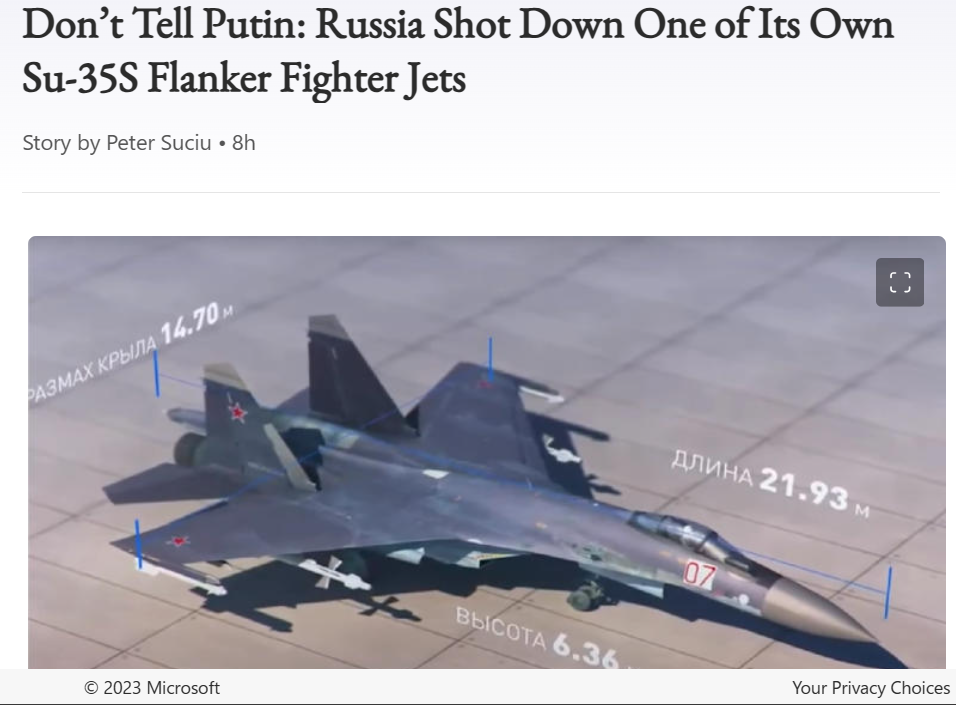
Russia shot down one of its Su-35S fighter-bombers.

  Russia shot down one of its Su-35S fighter-bombers. 


Human error, or somebody who might jam the jet fighter's IFF (Identification Friend or Foe) system, can cause this kind of episode. So if we talk about human errors, we should ask what caused those errors. Or maybe someone forgot to drive the IFF codes to the computers that control the AA systems. 

The jammer systems that deny the IFF system to transmit their codes to AA radars can cause situations where their air defense shoots aircraft down. Modern jet fighters and attack aircraft have only a couple of minutes or seconds to react when they see unknown, maybe hostile aircraft. If the aircraft comes closer to the headquarters would be an enemy attack aircraft, like the Ukrainian MiG-29 armed with "Storm Shadow" missiles, that aircraft could destroy the headquarters. 

One version of how to break the stealth technology is to use the IFF systems as the target.  AA crew can aim antiradiation missiles at the IFF system. Those radio transmitters are one vulnerability in stealth aircraft. 


The IFF system is a problematic part of the aircraft. The radio signal, that the IFF system sends makes aircraft vulnerable against the radar-homing missiles. Jammer systems that send radio signals to deny radar- or radio communication are vulnerable against antiradiation missiles. This means there are always new systems under development. 

Electronic warfare is becoming more important in modern battlefields. The drone systems require communication. And if the system can jam GPS and data communication. That makes it harder to use drones and communicate with troops. Also, jammers can deny the drone swarms internal communication. The jammer systems can be the target for HARM-type missiles created to destroy ECM systems and other radio transmitters. 

The stealth is the ultimate tool. But the next generation of radars and surveillance systems are hacking the stealth. The CCD cameras and lidar systems are making old-fashioned stealth useless. Same way next-generation AA radars might use pressure waves and other non-direct observation methods to uncover the stealth. The pressure waves around the aircraft are possible to detect by using AI-controlled systems that connect the data from multiple sources. 

And the weapon development is the race between the ultimate attacker and ultimate defender. The next-generation IFF systems might also use AI-based radar systems. The radar sends the identification request to the IFF system that answers that request. Then the AI starts to follow the aircraft that closes the IFF. And if it loses the target it can ask for identification again. That thing minimizes the need to send radio signals all the time. That helps stealth planes to complete their mission and makes them harder targets for enemy missiles. 


https://www.19fortyfive.com/2023/10/dont-tell-putin-russia-shot-down-one-of-its-own-su-35s-flanker-fighter-jets/


https://www.msn.com/en-us/news/world/russia-shot-down-its-most-advanced-fighter-jet-over-tokmak-uk-mod-says/ar-AA1hFMaT


Monday, January 16, 2023

The Chat GPT can be more than we ever thought.


The Chat GPT artificial intelligence is the next-generation tool for programming. Same way as the Chat GPT creates the homepage by connecting sources. It can create things like computer programs and websites for programmers. All websites, like web stores, are acting the same way. 

And that's why AI is the ultimate tool for programming. Maybe in the future, the person who wants to create a program just writes a description of the program for the AI. That description can involve the drawings of the user interface. Then the AI will collect the needed code from its database or the network. 

In the simplest version of the AI-based programming interface, the programmer just writes a description, of what the program must do. And then the AI searches the list of needed libraries and other things. In more complicated versions that might come soon, the AI can collect data from the open network or the libraries of some programming tool. 

The system needs only information about what the certain library does. The AI can interconnect Web-based data and the programming tools like Dev-C++ or some JAVA editor. 

There is the user interface and the program tower that is driving data to databases. Those program towers and databases are all similar. So the Chat GPT can make an individual-looking web service simply by modifying the program tower to fit the user interface. 

That program tower is written using some common programming language like Java or C++. In programming, books are enlisted codes for those kinds of tools. So by using a modified twain- or some other scanner program the users of the automatic encoding system can simply scan those codes from the books. And then drive them to the programming editor. 

So the programmer must just make the description for the user interface, and then the program will make the job. So in the future, the creator of web stores and other kinds of things must just draw the user interface. And then take a picture of it. Then the AI would modify the program tower fit to that user interface. 

There are stories. Russian hackers are trying to use Chat GPT for making viruses. And that's why AI- developers must be careful. In the wrong hands, those kinds of systems are dangerous. The programming model of Chat GPT is behind payments. But maybe there is soon free programming editors that are connecting programming and artificial intelligence. 


https://shorttextsofoldscholars.blogspot.com/


Tuesday, January 10, 2023

New research claims that Russian Twitter campaigns in 2016 didn't change voting behavior.


The Russian trolling campaigns have one problem. Makers of those campaigns believe in the authority and selfish ideology. So those campaigns are telling ideology, that is against the values of most Western people. Or those values against the ideology of Western social media users. Another thing that decreases the effectiveness of Russian trolling campaigns is that people know more about Russian and Russian internal affairs than in the past.  

The third thing that is is decreasing the effect of Russian troll campaigns is that people afraid that somebody will target them for cheating and trolls. If people are afraid to join those groups where propaganda- or information operations happen. Delivered information would not reach their targets.

We know that many people are afraid of trolls and other kinds of things. And we are all faced with cheating and trolling. The Russian trolls are operating under the control of the Russian government. And they sometimes use very bad language and terms like "bitch" about their targets. So, those words might seem funny, but they belong to some child's mouth. 

The thing is that criticizing Russian trolls is prohibited in Russia. The Russian government also uses trolls in the internal political area. If somebody doesn't believe Putin. And shows loyalty to the Russian government, that thing causes a very bad situation for a person who dares to talk against the government. The person who doesn't support the Russian government and the Ukraine war is automatically a Western agent. 

The difference between Western and Russian culture is that Western people are more critical than Russian people. The key element in Russian ideology is that "government's leaders are wise men, who are above the society". That is why nobody should review those people. The role of regular citizens is just to obey their leaders. If somebody is against their leaders that means discrimination, and that happens immediately. 

https://scitechdaily.com/russian-twitter-campaigns-during-the-2016-presidential-race-didnt-change-voting-behavior/

https://shorttextsofoldscholars.blogspot.com/

Friday, January 6, 2023

Revolutionary AI system learns by using text, video, and audio.


The new AI system can connect information, that it gets from text, video, and audio. This new AI-based system can connect itself with multiple systems more effectively, than ever before. And that thing makes the system very effective. 

At this point, we must realize one thing. The AI itself is a platform-free application. So the system can use things like robot bodies and surveillance cameras as the physical tool that increases its operational environment. If learning AI works with the robot. Their AI can operate as a visible control system. 

Or it can operate backward and send information to the central system. That central system interconnects data that it collects from the network, robots, and other things. That allows the system can collect multipurpose data matrix. That it connects data from multiple data-handling tools. 

Machine learning means the ability to connect memory blocks. Same way, when the human brain connects neurons to virtual neurons, the learning machine connects databases to new entirety. And that is one of the biggest advances in data sciences. 

But without data is no databases. And without databases is no learning. The problem is how to input data into databases. The answer is that the system can use cameras and microphones to get information. Those cameras and microphones can be installed in the robot's body. 

If the AI uses robots as the medium it's even more flexible than pure network-based solutions. The idea is that AI can operate as a hybrid application. In those models, the AI solution is a combination of software- and hardware-based solutions. 

Complicated algorithms require powerful computers and effective internet connections. For learning machines information is the material. That is used for making new solutions. Learning machines can make virtual solutions or physical solutions. 

There is the possibility that the AI makes virtual models like CAD images of the work. And if the engineer accepts it, the system will transfer it to industrial robots and 3D printers that make a physical product. 


https://scitechdaily.com/revolutionary-ai-system-learns-concepts-shared-across-video-audio-and-text/


https://shorttextsofoldscholars.blogspot.com/

Thursday, January 5, 2023

Drones are deadly weapons.


The Ukrainian war shows how effective tool drone is. The Russian air defense could destroy all Beyraktar drones. But before that, the Bayraktars terminated lots of Russian equipment and men. So the efficiency of those drones is good. 

Another name for loitering ammunition or kamikaze drones is cruise missiles. The problem is that almost anybody can make the kamikaze drone at home. Basically kamikaze drone is an RC airplane that carries explosives. 

There are also anti-tank versions of those loitering ammunition. Those versions are just artillery recon drones or target drones equipped with suitable warheads. 

And even if Russian air defense destroyed them.  Those drones played a big role at the beginning of the war. Today we see how effective cheap Iranian drones are against fixed Ukrainian targets.

Lucky for Ukraine, Shahed-136 drones are very primitive. They can fly by using fixed routes. And they don't even change altitudes. 

Shahed-136 cannot make any escape and evasion movements. So when that drone is located. It's quite easy to shoot down. 

And even if Ukrainian air defense shoots most of those slow drones. A couple of them are reaching targets. This is the key element in drone operation, lots of cheap drones can send at the same time, against multiple targets. The maximum speed of those drones is about 150 km/h. Even if those drones are easy to reach by using a car or combat helicopter. And they are easy to destroy. 

A large number of those loitering ammunition guarantees that some of them reach the target. Drones are like all other aircraft. They are hard to see but easy to destroy if the ammunition hits them. The new anti-aircraft missiles are effective against drones. But the problem is that they must see drones before they can be used. 


The price of effective missiles like Patriot is 3 million per shot. Their target price is less than 3000 dollars. The number of lost drones in missions in 2020 was 24. And it increased. But then. The high command can accept the loss of 24 drones because no friendly crews were dangered. 

The low price of the GPS systems means that the cheap mobile telephone can modify the brain of those drones. And GPS/GLONASS guarantees high enough accuracy that those drones can destroy or damage oil refineries, power plants, transformer substations, factories, and other large structures. 

The small drones that Ukrainians use against Russian infantry and armored vehicles are also very effective. Those drones are just little modified versions of drones that people can buy from supermarkets. 

Those drones are equipped with systems that can drop hand grenades at enemy positions. Sometimes those hand grenades slipped into tanks from the open hatches. And that destroyed those tanks. If those small-size drones are equipped with thermobaric hand grenades the lethal radius of those bombs is 30 meters. 

The Ukrainian military also used pocket-size killer drones that can take off individual shooters. In the wrong hands, those pocket-size drones can cause a big risk to national security. They can leave in position. And then those drones can attack their targets. The small miniature drones can control by using satellite data transmission. And those drones are giving ICBM missiles the ability to kill individual people from the streets. 

The killer drones and loitering ammunition can have similar target recognition and attack capacity as Javelin missiles. There are multiple different drone variants in use. Some drones are equipped with similar radiation-homing equipment with HARM (High-Speed Anti-Radiation Missiles). This makes them effective against radio transmitters. That kind of drone can destroy any radio source. 


The thing that makes drones dangerous is advancing technology. When we think that a 60 € mobile telephone can give drones the same accuracy that made in the 1990s by using equipment that cost millions of Euros, we must concern about the future. The reason for that is. All models that we made against drones are old fashion. 

Image recognition systems are giving drones pinpoint accuracy. And the first supersonic drones are in use. AI-controlled weapons are under development. And the fact is that the fear that Russia or China will be first is making other nations create new terminator weapons. If those international contracts limit that development, we are in big trouble. 

International contracts limit many things like the development of nuclear, biological, and chemical weapons. But those weapons are under development. 

International laws prohibit things like extortion. But somehow, those cases happen quite often. Drones are big ammo over the battlefield. If we think, that some country loses 24 tanks in the mission, that is not the end of the tank. In the case of war, we must realize that somebody doesn't care about contracts. 


https://www.aljazeera.com/news/2022/10/17/what-are-kamikaze-drones-and-how-did-they-get-to-ukraine

https://www.flightglobal.com/military-uavs/record-number-of-uav-shoot-downs-prompt-new-usaf-tactics-and-countermeasure-pod/138908.article

https://news.sky.com/story/ukraine-war-what-are-iranian-kamikaze-drones-and-will-the-us-send-the-deadly-mq-9-reaper-12737283


https://www.telegraph.co.uk/global-health/terror-and-security/drone-assassins-micro-killing-machine/


https://en.wikipedia.org/wiki/AeroVironment_Switchblade

https://yle.fi/a/74-20011489


https://shorttextsofoldscholars.blogspot.com/

Wednesday, January 4, 2023

The problem with quantum computing is: how to transmit information over long distances in a qubit.


"In a recent study, researchers achieved high-visibility quantum interference between two independent semiconductor quantum dots, a crucial development towards scalable quantum networks". (ScitechDaily.com/Dawn of Solid-State Quantum Networks – The Holy Grail of Quantum Information Sciences)

The limit of binary networks is that they are slow for quantum computers. If quantum computers connect to quantum networks. That makes it possible to connect them to one entirety. 

Quantum networks allow quantum computers to communicate without bottlenecks. And that will be the next revolution in the world of quantum computing. 

The ability to transmit the information as a qubit over long distances would be the next step in quantum networks. The quantum networks will be faster and more secure networks than regular binary networks. There is a possibility that the spectrum is the key to those networks. 

When we think about the spectrum we must remember that each spectrum's color is an independent radiation wavelength. So the information can deliver from the qubit to the different color lasers. And that allows researchers to make the photon-based qubit, where certain color or wavelength is the certain state of the qubit. 

A long-distance quantum network is also possible to create by using multi-band radios. In that version, data is shared to different frequencies. And then send it to the receiver. This kind of system can make a faster and more secure network. When we are thinking about the quantum revolution we must realize a couple of things. The next-generation network should be easy to use, but the same time very secure.  The quantum system is not yet common. 

But technology is advancing. When quantum computers are turning more common, their prices will get lower. The problem with quantum computers is that they can keep their quantum entanglements only in a couple of seconds. Then the energy level quantum entanglement will turn to the same. And that breaks the entirety. 

The requirement for information travel in quantum entanglement is that another side is at the lower level. When the energy level in that structure turns stable, it breaks the superposition. When this thing happens the quantum computer must re-adjust. For that is required high-power binary computers are. In that process the system superposition and entangled two elementary particles. The speed of that process depends on the computer system's ability to control the quantum systems. 


https://scitechdaily.com/dawn-of-solid-state-quantum-networks-the-holy-grail-of-quantum-information-sciences/


https://shorttextsofoldscholars.blogspot.com/

Tuesday, January 3, 2023

The new integrated data security requires hardware and software-based solutions.


New nanotechnology makes it possible to hack computers, even if they are off the internet. The cyborg bug or small robot can carry a microchip to the microcircuit. And then, the system can put that microchip on the wire or microprocessor. 

The microchip can record and transmit information to the relay station that resends to the satellites or the internet. Even if that microchip doesn't have powerful data transmitters, the system can use a chain of miniature relay stations that transmit data to the drone or a fixed station that can be a cell phone that communicates with those microchips by using BlueTooth. 

Those microchips can also transmit electromagnetic impulses to wires. And they can use to deliver computer viruses or spyware to polluted computers. 

If we think of the traditional locking system. The AI can easily make copies of the physical keys. The AI-based camera just photographs the keys, and then it can measure the length of the key. The system can also use sonar or laser scanners. And then, it can transmit that data to the CAM (Computer-Aided Manufacturing) system. 

That system can involve a 3D printer and machine tools. There is the possibility that the attackers have laser systems that they can use to finish the job. Modern burglaries can work for governments. And in that case, they can have high-tech support systems. 

The fact is that the wrong microchips can cause a very bad situation. There is a possibility that those microchips are equipped with logic bombs. In that case, those systems can deliver computer viruses to the system. Or they can transmit information that flows through them to a third party.  

And even if those microchips don't carry malicious code to the targeted system. They can cause very big risks. If hostile forces know the resonance frequency of those microchips. They can use acoustic weapons to make physical damage to microchips. That causes oscillation and breaks the core of the microchip. 

The data security of tomorrow must base the solutions that are hard to break. When we think about things like electronic locks there is the possibility that in the future, cell phones with biometric recognition systems can use to open electronic locks. 

But when the telephone communicates with locks it must use a very fast algorithm. The recognition algorithm can be unique. And that makes it easy to track the device. That code is used for authorized access in physical or software-based systems. 

The burst of code, hidden in empty code makes it difficult to steal the key. When the telephone starts transmitting it sends an "empty code". Then the key code is hidden in that message. The next-generation systems are not just denying access. It stores the unauthorized keys in memory, and that defender can find out where the attacker stole the code. 


https://scitechdaily.com/the-security-system-of-the-future-electronic-devices-could-use-logic-locks-to-fend-off-malicious-attacks/


https://shorttextsofoldscholars.blogspot.com/

Computer researchers published a new algorithm that revolutionizes web management.

The new database structures require new and powerful tools to manage databases in non-centralized solutions. The new data structures can be ...